Hello PARKSIDE fans, it’s blog time again, and boy is there a lot of ground to cover in this one!
In the last post, (which was posted EIGHT MONTHS AGO, by the way) I showed off a bunch of stuff I had been working on, including weapons, abilities, maps, but I still had a long way to go until the game was ready for beta testing.
Since then, I have reached a lot of goals, and as of writing this the PARKSIDE Private Beta has been running for about a month and a half now. It’s been a great success – the amazing beta testers have found many bugs and helped me to troubleshoot lots of issues that have previously plagued the game. PARKSIDE is now on track for the final stretch of development which will involve finishing the game’s cutscenes, intermission segments, and cinematics for the game’s two endings.
My pace of work has slowed down somewhat, since the birth of my awesome, beautiful, amazing, super rocket scientist genius baby daughter in October, but I am still going as strong as I can, often multitasking and playing with her, reading her books, singing, and hanging out with her while squashing bugs…
So what exactly’s happened since the last blog? Let’s break down some of the dev progress that’s happened since the last infodump…
Also, couple of weeks ago, I asked on Twitter and Discord if people had questions they wanted answered about the game’s development. At the end of this blog there is a Q&A section where I’ve done my best to answer these…
Cover art reveal
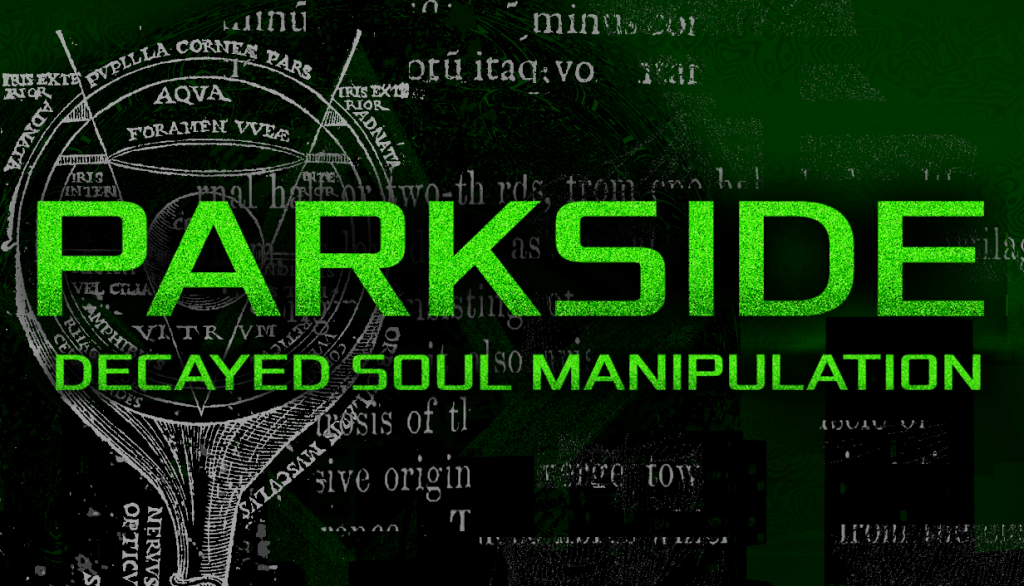
If you haven’t looked at the PARKSIDE demo in your steam library lately, or if you don’t follow the game on Twitter or BlueSky, you might have missed this one – the game’s cover/capsule art has finally been completed:
Visit more of scenic Abbotsford…
WARNING: This portion of the article contains spoilers for locations and scenarios in the latter part of the game.
From June to December last year, most of my time was taken up by finishing the game’s missions – there were five main maps to complete (that number includes two variants of one mission) and a cut/shuffled map was modified with new mission objectives.
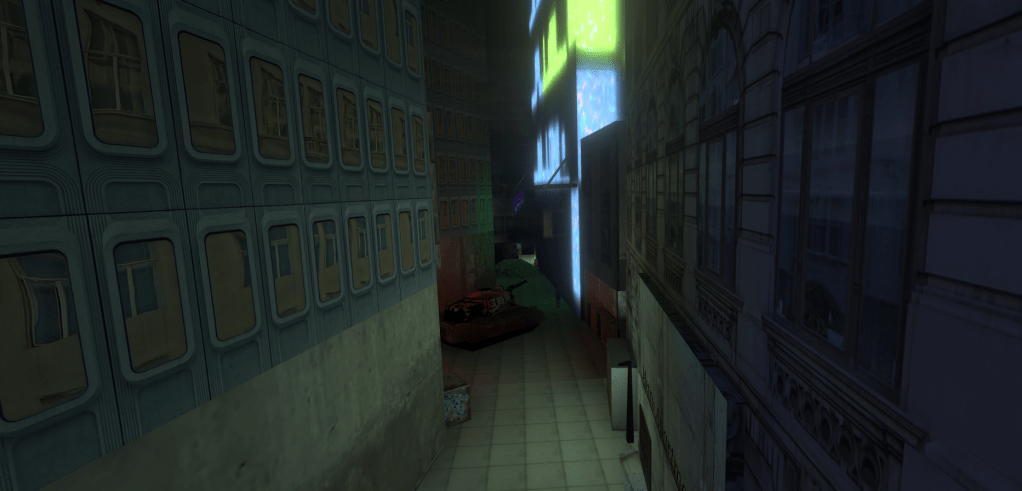
Gasworks Row & Lights District revisited
When I wrote the last blog, I was partially finished with ‘Gasworks Row’, an urban nighttime map which connects up with two earlier locations in the game, the ‘Lights District’ and ‘Clive Square’.
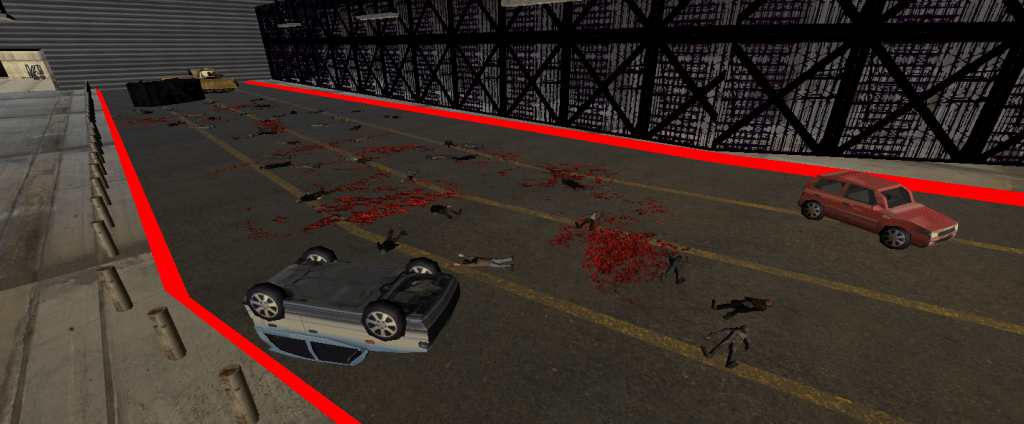
Dark alleys and gloomy industrial areas crawling with soldiers, what more could you want from an Immersive Sim level? I had fun creating a new part of the city, which acts as a “bridge” between two earlier locations in the game. I hope that this gives the player a sense that the game does not just take place in disparate, disconnected areas, but actually there is a feeling that it’s an interconnected city (even though it’s not in practical terms of course!)
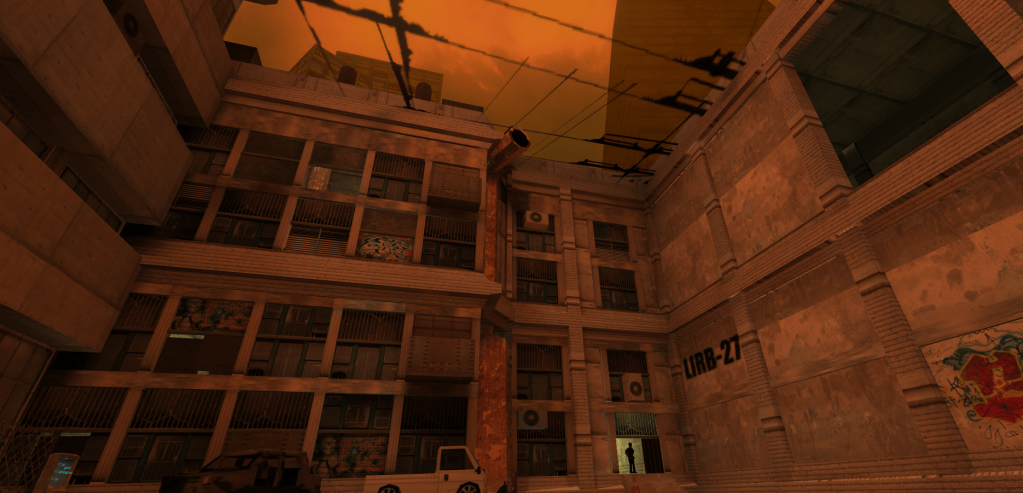
This mission is a two-parter: after you complete your objectives in this area, you are sent to LIRB-27, a residential ‘slum block’, to track down a target. This map was originally from earlier in the game, but it has been repurposed and revamped as a follow-up to Gasworks Row.
GENRAX Blacksite
A secret desert laboratory, a la Black Mesa, is one of the locations you will visit later in the game. It’s got twisting corridors and many different ways of traversal, including tunnels and sub-labs that hold dark secrets…
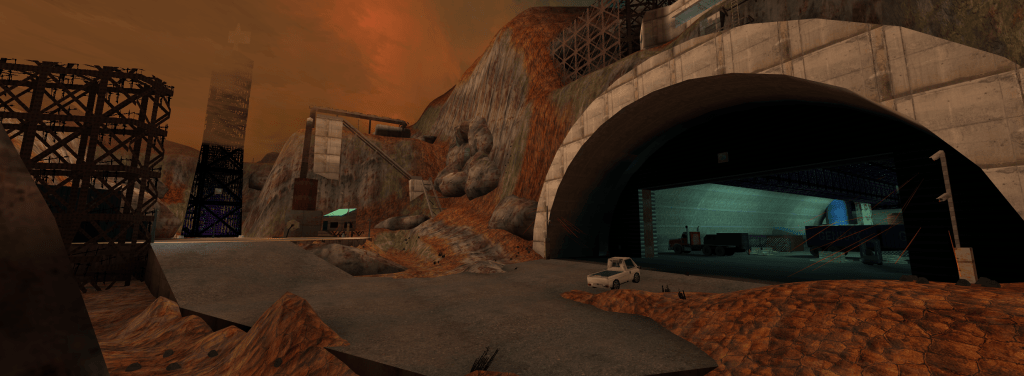
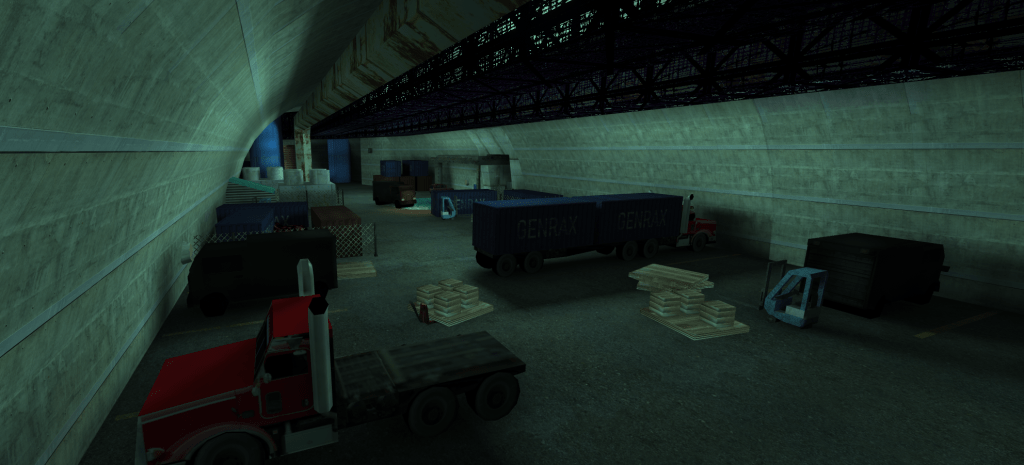
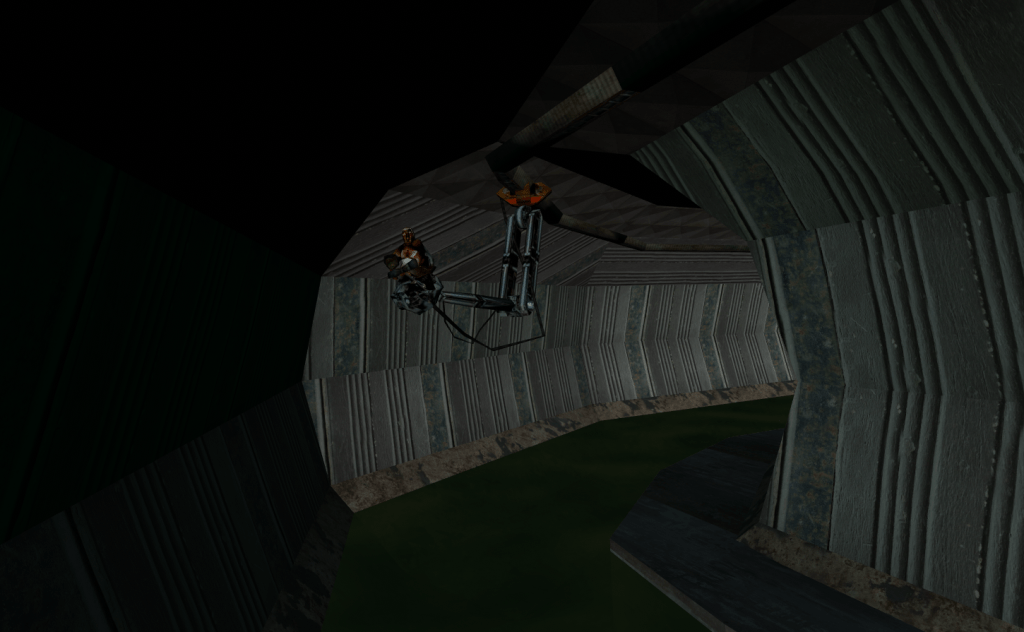
This mission has a unique enemy which I introduced in the last blog post, the “Railmen” previously known as Perma-Technicians. Their job is to keep the tunnels under the blacksite free of obstructions, a task that they are expected to undertake continuously, 24 hours-a-day. They manage this only because they are part man, part machine, spliced with technology that keeps them awake, alert, fed, and hydrated. Combined with brainwashing, they make the perfect janitors…
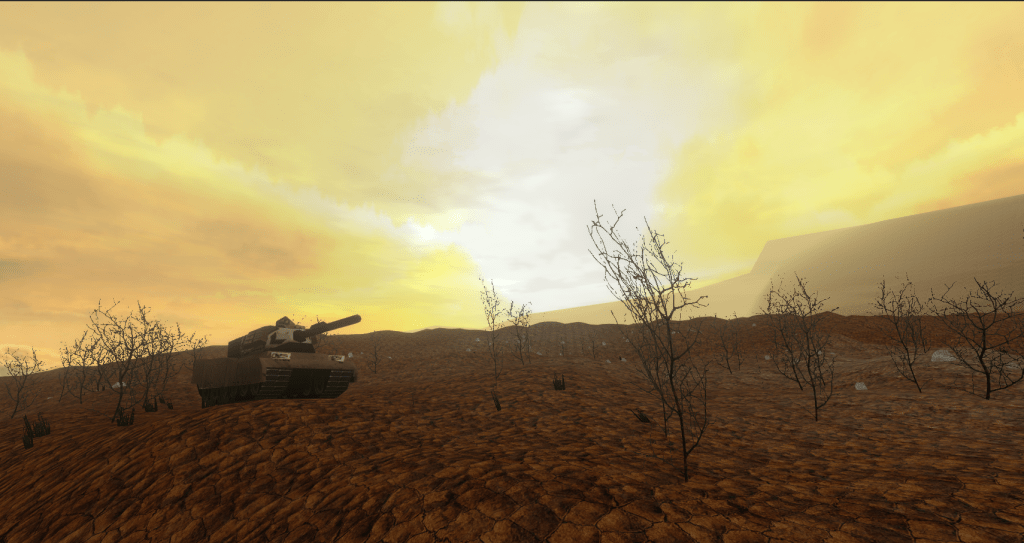
Desert Base
You will also visit and infiltrate a U.S. Army base in the desert outside the city, facing off against tanks, helicopters, and heavily armed (and well-trained) soldiers.
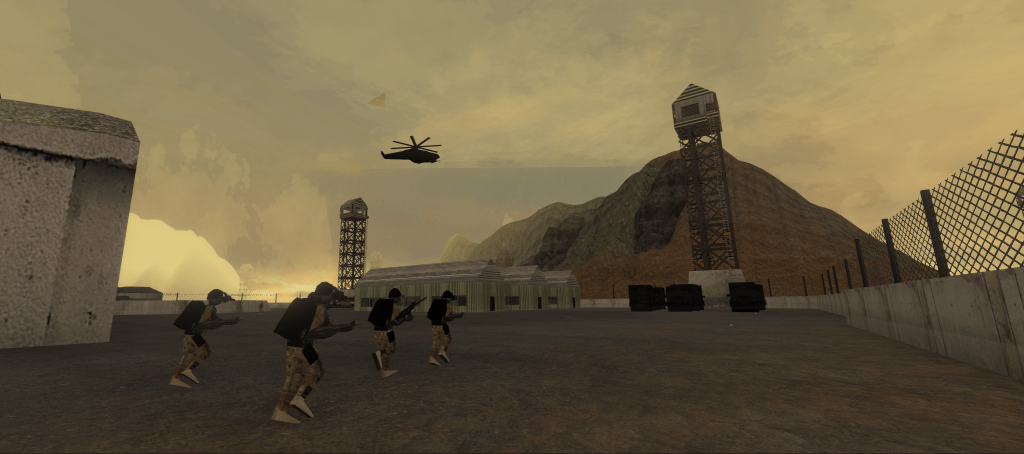
While the area is pretty straightforward to traverse, being mainly open terrain, this also presents a hazard, as you might find yourself at the mercy of snipers. Also, if you are spotted by a tank, pretty much your only chance of overcoming them is to either flee to safety or employ some explosive ordinance.
Abbotsford Crossing
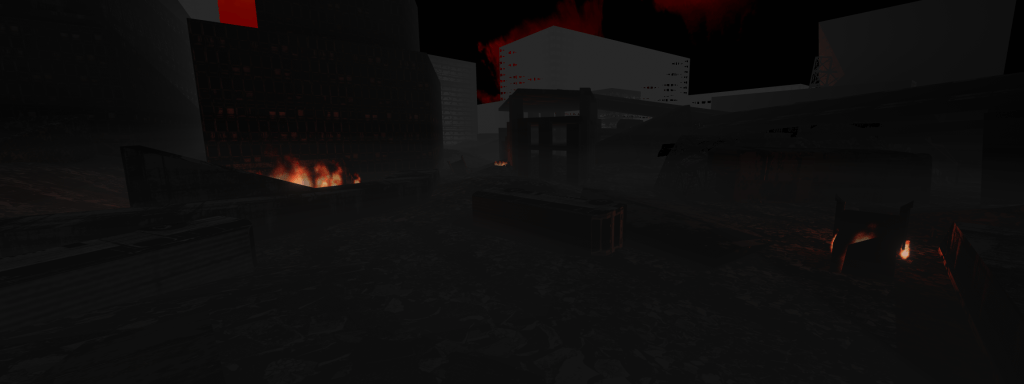
A large, sprawling section of the city is featured in the latter part of the game, and this is where your previous choices come to a head. Depending on what you do prior to this point, you will be faced with a partially destroyed but still liveable cityscape, or smouldering ruins.
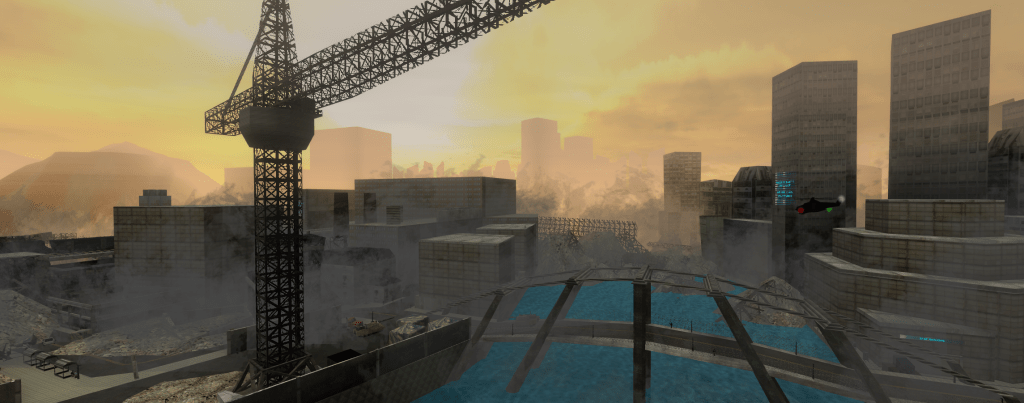
In the case of the former, it’s the “final gauntlet” before the thrilling conclusion (which won’t be revealed here – you’ll have to wait until the game’s released!) and in the case of the latter, it is a stark reminder that sometimes, you have to face the consequences.
Fixes-a-plenty
Following the completion of the game’s missions, I have been spending a lot of time fixing and refining gameplay elements, features, quality of life, so that when PARKSIDE releases it will be a game I’m truly proud of, and I hope that players will appreciate the extra effort I’ve been putting into a lot of major (and minor) systems.
Here is a list of just some of the things I’ve touched up, enhanced, and otherwise overhauled:
- Ballistics – weapons have an effective range and there is some damage falloff calculation. Also, gunshots can now penetrate windows also at the expense of damage.
- Enemy AI – I have fine-tuned enemy combat movement behaviour to be far less erratic but still dynamic enough to pose a challenge. The guard interrogation behaviour seen in the National Archives mission is being expanded to apply to more guards/enemies throughout the game so that not every scenario instantly becomes a shootout.
- User Interface – I have standardised, re-coloured and tweaked menus for clarity and style, made the cursor higher-contrast, and before release, other UI elements will get some final changes for visual clarity.
- Controller Support – PARKSIDE now has full gamepad support except for some of the Main Menu which requires some tweaking or is best used with a mouse. But once you are in the game you should not need to touch your keyboard and mouse at all. All the game’s inputs have been mapped to one controller layout, but I will probably add some alternate schemes as well.
- Portraits, intel, history, abilities – Every NPC that has proper conversation dialogue now has a correct image portrait in the UI window; where appropriate, every mission that requires it now has ‘intel’ e.g. a map, photo of your mission target, etc available in the menu; the ‘History’ box in the mission details screen has been given its own dedicated screen and every major decision you make is now recorded. It’s a great way to get a recap of your previous actions; any remaining bugs in the player’s abilities, or incorrect ability shop costs and problems with abilities carrying over from old save files has been fixed.
- Quality of life – I’ve added extra settings for separate X and Y look sensitivity, bloom toggle, gore toggle, extra 4:3 screen resolutions; other QoL includes being able to use the 1 – 3 buttons to quick select dialogue choices, a prompt asking if you really want to leave/finish the current mission, last equipped items are now auto equipped at mission start, clicking with no weapon out will bring out your last held weapon, and more.
- Visuals – New additive particle effects for fire and explosions, fixed night-vision effects and other minor tweaks
- Various bugs and optimization – I have spent a lot of time fixing bugs and edge cases, including everything to player movement and physics to major game-breaking errors, and various harmless (yet annoying) bugs that unnecessarily take up game performance, also better baked lighting which allows for more static render batching ultimately saving frames.
What next?
Well, as you can guess, this is the beginning of the final stretch. The current version of the game beta is playable from start to finish, but it is still missing cutscenes for the latter half of the game, as well as some small intermission maps where you get to explore the Brethren’s base between missions. It is also missing a final confrontation map after the “final gauntlet” and ending cutscenes. My focus for the next few months will be to complete this content, while also applying a final layer of polish to the existing maps.
The final touches to the existing maps will be minor but will have a big impact on the feeling of the game. This will include:
- Some more variety of NPC skins and unique “quirky” people with interesting dialogue
- Additional clutter, decoration (graffiti, signage) and lore text (a new UI window will be made especially for when you interact with things like books, newspapers, posters, to allow for more text to be read)
- Some extra secrets with additional XP awards, loot, and lore text
- More vendors, selling weapons and items, for money as well as other currency or in exchange for other items
- One or two missions that do not have secondary quests will get some minor extra objectives
- More variety in enemy behaviours (more enemies will have the “interrogator” behaviour, asking the player for ID or telling them to leave locations before attacking)
Realistically, I should be able to achieve this in a timely manner because the underlying systems of the game to support all this content is totally finished – in other words, it’s a lot of drag-and-drop and of course writing dialogue. But it’s all totally worth it, because this work will breathe more life into the world of PARKSIDE and it will give players much more to experience and explore with not much effort on my part.
Finishing the game’s cutscenes (and fixing some of the animation of the existing ones) will be the most time-consuming part of the final stretch, but it’s crucial to hit the right tone in order to carry the story forward in an engaging and believable way. This will involve composing new music for many of the cutscenes, but also, I have some tracks from cut maps or that are otherwise unused that will fit some of these cutscenes and intermission maps perfectly, saving me some time.
So, keep an eye out in the Discord server or on the socials for more progress – it’s been quiet on the social media front lately just because I have been busy fixing all the technical issues I listed in the previous section (not very photogenic work) but once I have more visually interesting stuff to show, I’ll be posting more frequently again.
And now, for some…
Questions & Answers!
“What game truly inspired you” or “What inspired you to make PARKSIDE?”
My inspiration came from all over the place. I may have mentioned in a previous blog, maybe not, but PARKSIDE was originally not really going to be an immersive sim. It started out just as a little weird sandbox shooter experiment that I began working on out of a need to do *something* with myself during a difficult time. Eventually I began turning it into an immersive sim, and my inspirations came from all sorts of games.
Of course, predictably, Deus Ex is at the top of my list of inspirations. But I drew inspiration from a bunch of different games across the general shooter game spectrum – F.E.A.R. for example (slow-mo was the first ability I made for the game), Fallout 3 and New Vegas, Pathologic (or at least some of the philosophy behind Pathologic), Dishonoured (another big one for imsim nerds), Half-Life 2 (and its infamous Beta) and more.
Inspiration of course does not just come from other games… The themes of PARKSIDE, which delves into conspiracies like the Freemasons, and technocracy, obviously have some parallels to real-world happenings, but I did not want to “preach” about my woes with this planet we live on, at least not in an explicit way that would end up just being cumbersome eye-roll fuel for the player. Some things are left up to interpretation but not too much, not in the “obscure pretentious art film this guy on Letterboxd recommended” way, but also many of the themes are obvious and easy to unpack and enjoy.
Of course, with the game being cyberpunk/sci-fi dystopian in nature, I was inspired by film, but I couldn’t really say if a specific movie was a particular influence. We consume so much visual content these days that the interesting stuff kind of gets absorbed without us realizing it…
I can’t say I drew much inspiration from literature; I have seen discourse online and among indie game developers specifically that it’s bad to primarily be inspired by other games when you make your own game because it’s too derivative, or something like that, and that you should be more inspired by literature, art, and film… I am not sure about this idea, it doesn’t sit right with me, I’m not ashamed to say that a lot my inspiration came from the great games that came before mine, and in practice this is totally fine as long as the end product is not too derivative and that it has its own unique, good, fun gameplay elements and aesthetics.
“Is there some sort of standard or goal you had in mind for how PARKSIDE should feel and play?”
It took a few iterations for me to reach it but my goal for the game feel was “retro FPS” without feeling like it’s trying too hard to emulate say, Quake or Half-Life. I didn’t want any of the gameplay elements, graphics, etc. to feel like I was trying to copy old games (that’s why for example there’s no PSX vertex wobble…) rather I wanted it to feel new and fresh, while it just so happens that the game looks and plays like it’s from the 2000s.
I wanted the player to feel like they are in a true sandbox scenario while having clear goals. Deus Ex and Dishonoured did this extremely well and it was my intention to recreate that feeling. For example, the first mission of PARKSIDE, where you have to assassinate Jonas Reeves, was my attempt at making a true sandbox microcosm of “what to expect for the rest of the game.” It’s a miniaturization of what makes PARKSIDE, PARKSIDE. It’s just one city block, but there are so many ways to reach and kill the target, that it puts the player in the proper mindset for the rest of the game and what to expect. There is a separate training mission that teaches you the controls and how to play the game, but Mission 1 was designed to teach the player how to truly PLAY the game.
The world of PARKSIDE is in the vein of the original Deus Ex in that it is an attempt at a near-future scenario that is grounded in reality and is believable, and the far-fetched supernatural elements do not feel out-of-place because in a way, everything else fits. This also may be aided by the fact that our real world is going down the shitter real fast – the idea of Freemasonic technophiles who worship an unseen force kidnapping people and forcing them to pilot biomechs in order to aid their goal of conquering the Government doesn’t seem too far-fetched in the big ’26, does it?
Player choice is important to me in every way and that’s also why I chose to allow totally open progression when it comes to player upgrades. All of the 50-or-so abilities and upgrades are purchasable from the start of the game, the only limitation to your customization is the fact that throughout the story, you are not awarded enough Experience Points to purchase every upgrade. Therefore, you are forced by this scarcity to specialize. I didn’t want the player to have to deal with skill trees or stare at stats, numbers, and percentages – I feel this would only have detracted from the experience. Same with inventory management, there is no weight or item limit (except for ammunition for different weapons) so you don’t have to spend ages dealing with your items. You can click and drag items to rearrange them in your inventory, but that’s it. In some ways, less is more.
Music, SFX and ambience are probably one of the most important elements of a game for me, or in fact any kind of multimedia. That’s why I took care to make the soundscape of PARKSIDE unique and interesting, including adding different levels of reverb to different areas including inside vents and tunnels. PARKSIDE was my first proper foray into music “production”, and I learned everything I know now during the course of the game, so I feel pretty lucky that people like the soundtrack.
“What have been the biggest problems and concerns you’ve run across with creating an im-sim?”
Because everything is systemically interconnected, often I found myself in a cycle of fixing one problem, only to have two others pop up in its place.
As with many things, you may find yourself going into a scenario with a plan, with good intentions, with “best practices” that you want to abide by… and then, a few hiccups, hitches, hangups later, you find yourself writing spaghetti code, patching metaphorical leaks with duct tape, trying to keep the ship afloat!
Something that took up a bunch of my time, as an admittedly inexperienced indie developer, was doing things poorly or the “wrong way” initially and going back and cleaning up my mess. (Includes things like physics interactions or calling complicated functions and coroutines in parts of code that would cause poor performance). I spent a lot of time fixing and optimizing my own code just to make the game run better.
I encountered a lot of problems just getting systems to work well with each other as well. Strange edge cases and unexpected behaviours after fixing or improving things has been common but that is to be expected when making an imsim.
A concern that ended up not being a problem was worrying about whether my levels were designed to be “im-simmy enough”. Are there enough traversal routes? Is there enough variety? Something I tried really hard to impose was a feeling of maps being larger than they are – something I managed to achieve. Level design was not so much a problem, just a source of anxiety for me. In the end a couple of maps were cut (one was remade, the other one was totally scrapped).
“Do you have any regrets”
Not really, but if I had to pick one, maybe it’s overambition, but that’s pretty standard in game development, and part of the process of making a game is narrowing the initial scope to something refined and doable. I initially wanted the game to have full-on branching paths, two sets of missions and you could jump between ‘timelines’ depending on choices. I also wanted there to be 3 distinct endings – there may still be 3 ending cutscenes (depending on a dialogue choice) but in terms of branching paths, there are 2 ending chapters triggered by 2 distinct game paths.
I also kind of regret not doing things more systematically to begin with, but that’s just how my brain works. I can’t spend years in a greybox dev room map getting the gameplay finished before making the content, I would go insane. I bounced back and forth between maps, graphics, gameplay, sound, animation, all over the place for the first couple of years. Got a good baseline for each, then made the demo/”vertical slice”. Then I became systematic – finish the weapons. Finish the abilities. Finish the maps. Fix the bugs.
Other than that I don’t really regret a thing.
“What are the 3 most difficult bugs you encountered so far?”
If I had to rank them, from least to most worrisome:
#3: Water issues – Swimming is not an easy thing to implement in games in general. It wasn’t getting swimming to work that was problematic for me, but rather an obscure bug where sometimes, if you got out of water, the player would still act in some way as if they were still underwater, or drowning. This applied to scenarios including getting on a ladder out of water, or just having previously been in water and then going elsewhere in the map, to a point lower than the waterline of the water you were previously in, and then you’d start swimming in thin air. It was a combination of a few little bugs that needed squashing.
#2: Gibberish and silence – Branching dialogue systems come in many forms. People have made packages for Unity and other engines just so that people don’t have to write their own. I am a dumb dumb and decided to write my own. Sometimes I’d make typos where the game wants to know what the next conversation state should be and this would lead to dialogue dead-ends, or I’d fuck something up elsewhere and an NPC would start speaking in tongues. Very fun.
#1: Total gamebreak – This is something that plagued me since the first demo (and it can still happen in the current demo sometimes) and it’s a really weird one. Sometimes the player controls would totally glitch out for seemingly no reason, or you would suddenly phase through doors, not be able to talk to or attack NPCs, or anything. You would think that this was a problem with the player control scripts, I spent ages refactoring it and putting certain functions into custom periodic ticks to try and spread load, separating physics from other methods… But it was not a problem with the player. It was a problem with other NPCs or entities in the scene that were reading their speed based on distance from where they were last frame and the current frame. That seems like a standard thing that happens in games, right, but when the game was paused or the timescale slowed down, or other things happened (e.g. players with high refresh rate monitors had the bug a lot), without protections in place, this would produce glitches that “overloaded” the physics system in some way. I am not an expert on this but my theory is that, apparently in Unity, if too much is happening within one physics tick/frame (usually calculated at 50fps), any remaining code for that tick is skipped. Therefore, a bunch of stuff to do with the player control (registering what the player is looking at, shooting etc.) was not occurring leading to a gamebreaking bug that took me legitimately about a year to fully figure out. It could still happen, who knows…….. I hope not……
“Why do we play as a bio-drone rather than a human soldier? And how did you face narrative challenges regarding this?”
I wanted there to be an element of subtle body horror, and discomfort with the very nature of the player character. Playing as a normal John Shooterman is great but the idea of a loser being forced to inhabit a cybernetically violated flesh golem is just on another level in my opinion. It also adds mystery to the guys who are forcing you to pilot Polyphemus – isn’t this too much work? Can’t they just send regular agents out to do their bidding instead? How powerful are they really if this is just child’s play to them? I think it creates more narrative opportunities than challenges. The fact that this sickening creature can (mostly) fit into society in the year 2038, catching just a bit of flak from passersby for looking sick or ugly, adds some subtle richness to just how fucked up the world is in PARKSIDE. I don’t think I can discuss too much without revealing spoilers but this was a good question.
“What’s an estimate of how many weapons we can mess with and will there be the ability to hack NPCs’ brains?”
In the game there are 23 weapons (this number includes your fists) and a bunch more grenades, landmines, and gadgets which are not included in that number. There is a selection of melee weapons, each with a special attribute, and a ‘smartgun’ that can be equipped alongside any other weapon, that fires at targets automatically. Some weapons are non-lethal.
There is an ability in the game called ‘Biohack’ that lets you take control of a human NPC. You can move them around and attack other NPCs, even walk them straight into water and make them drown.
“Would you still love me if I was a worm?”
No comment.
And on that high note, that’s a wrap for this blog post. Thanks for sticking this one out and reading to the end! Given the frequency of these things, the next one very well may be posted after the game is finished.
As always, look out for updates on Twitter and BlueSky, and feel free to join the BananaHardsoft Discord server if you’d like to harass me. All the links you need can be found here on my Linktree: https://linktr.ee/bananahardsoft
Stay sexy…
-BananaH
 PARKSIDE: DECAYED SOUL MANIPULATION
Leave a comment